

[ A scanned image from a vintage veterinary instrument catalog]
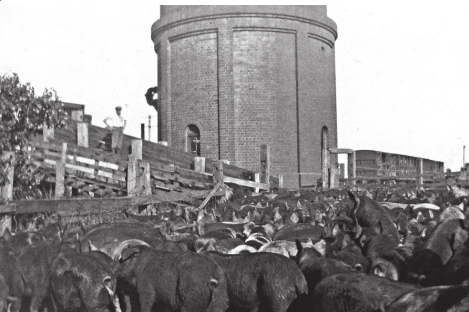
[A historical photograph showing a densely packed herd of pigs within a muddy stockyard or pen. A solitary man stands and looks over the pen.]

[A scanned page from a manual detailing the steps for surgical piglet castration, with no mention of anesthesia or pain relief]
[ A scanned image from a vintage veterinary instrument catalog]
Surgical Castration in the American Pork Industry
Since the early 1900s, the American commercial pork industry has relied on the surgical castration of male piglets to prevent an accumulation of “boar taint.” The combination of Androstenone and Skatole produces an unpleasant smell and taste that develops in male pigs as they reach adulthood. While surgical castration effectively eliminates this taste problem for consumers and aggression problem for producers, it poses problems for pigs. Historically, piglet castration has been and continues to be carried out without any administration of pain relief or anesthesia.
Surgical castration of piglets is most commonly performed when the animals are neonatal, averaging 3 to 14 days old. The procedure is performed almost universally by farmers or veterinarians without the use of general anesthesia. The piglet is restrained, held by its hind legs to expose the scrotal area. Next, the operator makes two incisions into the scrotum to expose the testicles. The testicles are pushed out through the incisions and then pulled to expose the spermatic cords, which are cut. The cutting is performed with a scalpel, though, less commonly, some operators tear or crush the cord to help reduce bleeding. Lastly, the incisions are left open to heal and drain naturally, without any pain management throughout the procedure. Following this process, piglets may undergo observable suffering, often characterized by stress vocalizations, along with physical behaviors, such as isolation, reduction in activity, and trembling. Primary observational research confirms the severity of this process and experience. Researchers documenting first-hand accounts of the procedure note that the lack of pain relief can lead to piglets undergoing acute physiological distress, displaying “behavioral alterations”, like “inactive standing or sitting, tail wagging, and aggressive behavior” as they deal with the pain of their wounds.
The experiences of these piglets cannot be advocated against by themselves; as such, the ethical responsibility falls on human caretakers and veterinarians to acknowledge their path of pain. The issue is that pain management remains largely absent due to economic and logistical barriers. Implementing large-scale pain management requires time, labor, and financial investment, things that large-scale farms typically avoid to maximize their profits. During a clinical focus group, swine veterinarians “acknowledged the importance of pain management from an animal welfare standpoint,” identifying several roadblocks, citing specifically that “economic limitations and challenges” and the “lack of approved products validated for efficacy” in the United States. The prioritization of profit over animal well-being creates a challenging work environment for veterinarians. As a result, pain management techniques often remain unchanged from where they were decades ago, prioritizing the economic viability of the final pork product over the documented pain experience of the animal from which it came.
Historically, this practice is critical for evaluating the ethical implications of modern agricultural and veterinary practices. This ongoing resilience between pork producers and veterinarians highlights a deeply rooted systemic issue in American agriculture. One that deems it okay to treat the physiological pain of a subject secondary to industrial efficiency.
Sources:
Špinka, Marek, editor. Advances in Pig Welfare. Woodhead Publishing, 2018.
Wagner, Brooklyn, et al. "Identifying Barriers to Implementing Pain Management for Piglet Castration: A Focus Group of Swine Veterinarians." Animals, vol. 10, no. 7, 2020, p. 1202, https://doi.org/10.3390/ani10071202.
Yun, Jinhyeon, et al. "Behavioural Alterations in Piglets after Surgical Castration: Effects of Analgesia and Anaesthesia." Research in Veterinary Science, vol. 125, 2019, pp. 36-42, https://doi.org/10.1016/j.rvsc.2019.05.009.