CHILDREN'S EXHIBIT
Some of the most vulnerable in the human population, children have historically found themselves as subjects of medical curiosity.
PLEASE NOTE: Images and descriptions displayed in this museum may be disturbing for some viewers.
Discretion advised.

TETANUS IN INFANTS
As medicine has progressed, the cause of neonatal tetanus is now known and prevention and treatment are available. However, in inquiring about its potential cause, one doctor’s experimental treatments on enslaved children created more harm than good.
[image: Wellcome Library, 1884. Diagram depicts deformed skull of an infant with Trismus nascentium, or neonatal tetanus.]


IT’S COMPLICATED: C-SECTIONS IN U.S. MEDICINE
Before cesarean sections, doctors took drastic measures to deliver a baby with minimal harm to the mother. Yet, the development of the modern-day cesarean section also had a rocky start.
[Image: Living Mom (2013). Depiction of a cross-section of a pregnant woman’s abdomen. Baby is being taken out by hand through a hole at the top of the abdomen.]
MASKED INTENTIONS WITH FENFLURAMINE
In an area of risk for side effects and social consequences, Black children endured a study, seeking to link behavior with genetics, through being injected with a drug while having their blood drawn every hour.
[image: Jordan, Isip, (April 4, 2000). An artist's depiction of a man standing over a child, measuring his head.]


PEDIATRIC SPINAL TAPS
Lumbar punctures, though widely used today to test for meningitis and to administer various medications, were not always so popular. The original experiments testing this procedure on children maybe have proved to be painless and harmless but would lead to many unforeseen complications.
[Image: Science Photo Library. Infant receiving a lumbar puncture.]


ELECTROSHOCK THERAPY TO CURE THE “MENTALLY ILL” CHILDREN
As the medical practice around mental health began to increase in the mid 1900s, the use of electroshock therapy seemed to be the antidote to “cure” these individuals.
[Image: Museum of Health Care, c. 1960. Lektra Laboratories Electroshock Therapy Machine.]
HEPATITIS HORRORS IN WILLOWBROOK STATE SCHOOL
The continuous spread of early hepatitis in New York in the 20th century lead researchers to infect young mentally ill children in Willowbrook State School with hepatitis in hopes of finding a cure.
[The Life Images Collection/Getty Images, 2020. Large room showing children laying in makeshift 'beds' in Willowbrook State School during hepatitis study.]


THE LOS ANGELES MEASLES VACCINE STUDY
During a large measles epidemic in the U.S in the late 80’s the CDC wanted to test the effectiveness of an experimental and dangerous measles vaccine. Beginning in 1989, the Los Angeles Study began by testing on 1,500 babies from minority families without informing parents of its risks.
[image: Awadu, 1996. first published article revealing the discriminatory measles study]


HENRY HEIMAN AND THE GONORRHEA CHILDREN
When it comes to understanding diseases, doctors use human experimentation and studies to learn as much as they can about how things react to the human body. This becomes an issue, however, when scientists move from consenting adults to nonconsenting, unknowing children.
[image: Library of Congress, 1940. Image of children lined up to be immunized.]


MANIPULATION OF DATA FOR MMR VACCINE TEST
The development of the MMR vaccine left people questioning whether the vaccine can cause autism. The development of the MMR vaccine left people questioning whether the vaccine can cause autism. Unfortunately, physicians and organizations involved made unethical procedures.
[Image: Akpan, 2019. Stock image of the preparation of the MMR vaccine.]
INFANT BLOOD
US newborn screening detects genetic disorders early through a simple blood test before infants leave the hospital. However, concerns about the retention and use of samples have emerged, leading to calls for standardized consent and increased privacy protections.
[Image: Soundarya V, FirstClass. Dr. Robert Guthrie performing a heel prick test on a new born baby]


THE SCIENCE CLUB
In the 1950s, Researcher Robert S. Harris, along with other researchers, performed experiments looking into the intake of calcium and iron in children at the Fernald boys School. The calcium and iron were laced with radiation, and the parents of the children were not informed of the presence of radiation.
[Image: Crockett, 2015. Ten boys from Fernald State School, standing shirtless in front of a blackboard in a line.]
CRYING BABY ≠ PAIN
In the early twentieth century, researchers like Myrtle McGraw helped shape the debate over whether infants could truly feel pain. Through experiments such as her 1941 “Pinprick Experiment,” McGraw studied how babies responded to physical stimuli, often interpreting their reactions as simple reflexes rather than evidence of real pain.
[Imagine: University of Colorado, Department of Pediatrics. (2022). CU Department of Pediatrics: A History 1930-2018. Issuu. Dr. L. Joseph Butterfield testing the movement and reactions of a newborn infant.]


TUBERCULIN TRIALS
In 1908, three respected Philadelphia physicians turned an orphanage into a testing ground. Knowing full well the damage it would cause, they applied tuberculin directly to the eyes of over 160 children and 17 infants at St. Vincent's Home, documenting their suffering in clinical detail while doing nothing to stop it.
[Image : New york times (1910). News article about the Tuberculin experiments from the New York Times 1910 ]
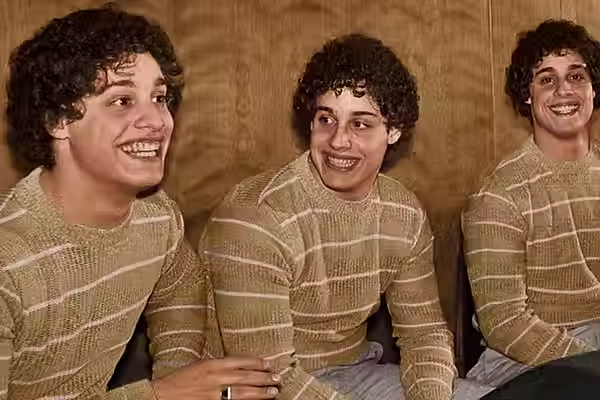
TWINS SECRETLY SEPERATED
In the 1950s Louise Wise Services adoption agency separated twins put up for adoption with the belief that this separation would be better for both the parents and twins. In the 1960s, this practice transformed into a study that is currently steeped in mystery and hurt.
[Image: Wardle, T. (2018). Picture of Edward Galland, David Kellman, & Robert Shafran, triplets separated by Louise Wise adoption agency. In newsday.com.]