

MRI of a meningioma in the brain. Meningioma: Diagnosis and Treatment, National Cancer Institute.
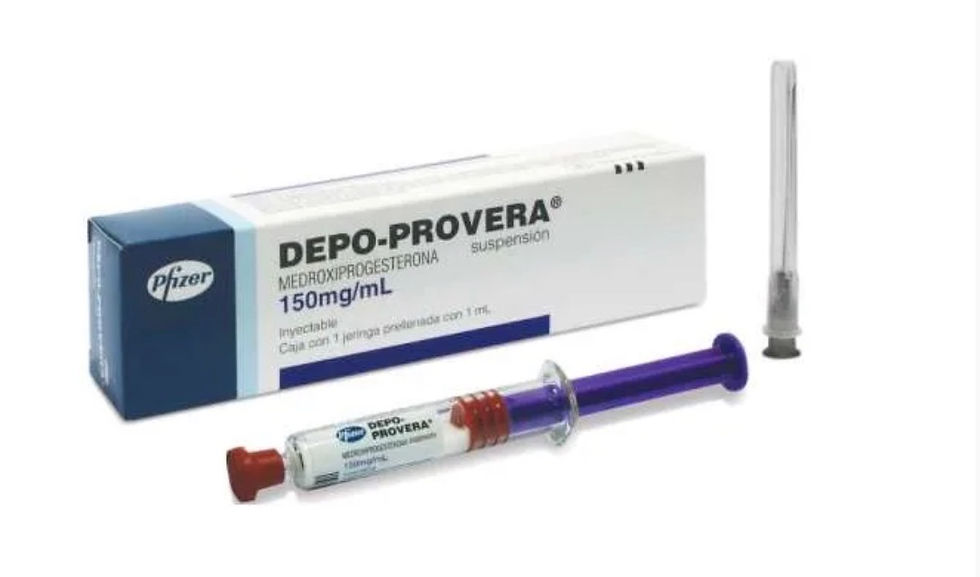
Depo-Provera Prescription Packaging, By MedWholeSaleSupplies.

Novak Jones, Diana. Pfizer Says It Couldn’t Have Warned about Tumor Risk in Depo-Provera Lawsuits, Reuters.
MRI of a meningioma in the brain. Meningioma: Diagnosis and Treatment, National Cancer Institute.
HORMONES AND HARM: THE OVERLOOKED LINK BETWEEN DEPO-PROVERA AND BRAIN TUMORS
The long-acting injectable contraceptive Depo-Provera, which is used by millions of people, has been the subject of growing legal attention in the US in 2025 and 2026. The medication, which was produced by Pfizer and authorized in 1992, has long been marketed as a practical method of birth control. But an increasing number of cases now claim that patients were not sufficiently informed about possible neurological dangers, especially the emergence of brain tumors.
The synthetic hormone that fuels Depo-Provera, medroxyprogesterone acetate, is at the heart of these assertions. Concerns regarding a potential link between extended exposure to progestogens and meningiomas—tumors that develop in the membranes protecting the brain and spinal cord—have been highlighted by scientific research conducted within the last ten years. Meningiomas can nevertheless cause severe symptoms, such as seizures, eyesight issues, cognitive deficits, and persistent headaches, even though they are frequently categorized as benign.
Long-term usage of progestogen-based drugs may raise the risk of tumor development or growth, according to recent research, including a 2023 study published in The BMJ and earlier findings in JAMA Neurology. Concerns about a potential connection were heightened in several instances where patients' tumor growth reduced after stopping hormone treatment. These issues are now present in courtrooms as well as scholarly publications. Numerous cases filed nationwide as of 2025–2026 allege that manufacturers did not give enough warnings about the risk of meningiomas connected to long-term Depo-Provera use. Patients were allegedly denied the information they needed to make well-informed decisions regarding their health, according to legal allegations.
The stories of actual women lie behind these cases. Before imaging showed a meningioma, one plaintiff, a nurse in her early 40s, had years of inexplicable neurological symptoms, including severe headaches, disorientation, and trouble speaking. She had been on Depo-Provera for a long time. After using hormonal contraceptives for years, another woman claimed to have been diagnosed with a tumor "the size of a golf ball." Both needed major brain surgery, and they are currently undergoing continuous monitoring and long-term recuperation. These stories, according to lawyers, are not unique. Similar examples are starting to appear around the country, which might lead to widespread product liability lawsuits. A move toward coordinated legal action is indicated by the fact that law firms are actively looking into allegations.
Concerns around informed consent are not new, but the cases are. Decades ago, advocates like Judy Norsigian and the Boston Women's Health Book Collective cautioned that Depo-Provera was frequently sold to underprivileged groups without clearly communicating the risks. Many claim that these trends might still exist now. Many patients claim they only became aware of possible hazards after being diagnosed, despite the fact that the U.S. Food and Drug Administration is still keeping an eye on the medication. The outcome of the lawsuit could influence how medical hazards are explained and whether or not patient experiences result in long-lasting change.
References
Boston Women’s Health Book Collective. Our Bodies, Ourselves. Simon & Schuster, 1973. https://archive.org/details/ourbodiesourselv0000unse/mode/1up
Boston Women’s Health Book Collective. Our Bodies, Ourselves. Simon & Schuster, 2011.
Cea-Soriano, L., et al. “Use of Progestogens and the Risk of Intracranial Meningioma.” The BMJ, 2023, 382, e074870.
“Depo-Provera.” Childbirth Injuries, https://www.childbirthinjuries.com/product-liability/depo-provera/. Accessed 5 Apr. 2026.
“Depo-Provera Prescription Packaging.” MedWholeSaleSupplies, https://medwholesalesupplies.com/product/depo-provera-150mg-1-1ml-prefilled-syringe.
“How to File a Depo-Provera Lawsuit.” Robert King Law Firm, https://www.robertkinglawfirm.com/personal-injury/depo-provera-lawsuit/how-to-file-a-depo-provera-lawsuit/. Accessed 6 Apr. 2026.
King, Robert. “Depo-Provera Lawsuits Advertisement.” Robert King Law Firm, https://www.robertkinglawfirm.com/personal-injury/depo-provera-lawsuit/how-to-file-a-depo-provera-lawsuit/.
“Meningioma: Diagnosis and Treatment.” National Cancer Institute, https://www.cancer.gov/rare-brain-spine-tumor/tumors/meningioma.
Novak Jones, Diana. “Pfizer Says It Couldn’t Have Warned About Tumor Risk in Depo-Provera Lawsuits.” Reuters, 25 Aug. 2025, https://www.reuters.com/legal/litigation/pfizer-says-it-couldnt-have-warned-about-tumor-risk-depo-provera-lawsuits-2025-08-25/.
Weill, A., et al. “Long-Term Use of Progestogens and Risk of Meningioma.” JAMA Neurology, vol. 78, no. 5, 2021, pp. 1–9. https://pubmed.ncbi.nlm.nih.gov/38537944/